16
Nov
The stark law is a complex regulatory framework that focuses on physician financial relationships with entities in which a physician could refer certain services. The stark law (42 u.s.c.
What is the stark law. The stark law is a public service law that prohibits practitioners from making improper referrals when there is a conflicting financial interest. Energy, mining, intellectual property, cybercrime, libel, election law Ad business registration, corporate law, family law, criminal law, immigration law, visa.
This means that you must have intended to break the law in order to be charged under it. Stark law is a law that can result in hefty violations for physicians and medical practitioners if violated, so understanding the law in its entirety is vital to preventing legal issues that may arise as a result. As an insurance agency with roots in the medical field, unity insurance, formerly medchi insurance agency, understands the.
Stark law and the aks and, as a result, complete alignment between the exceptions to the stark law and safe harbors to the aks is not feasible. The stark law is a complex regulatory framework that focuses on physician financial relationships with entities in which a physician could refer certain services. What is the stark law also known as?
Stark is a strict liability law. The stark law is a strict liability statute and requires no proof of intent. The stark law is a healthcare fraud and abuse law that prohibits physicians from referring patients for certain designated health services paid for by medicare to any entity in which they have a “financial relationship.”
The stark law does maintain a definition of fair market value but it does not dictate actual numbers. The stark statute has generated confusion and anxiety among physicians. The following definition is from the regulations:
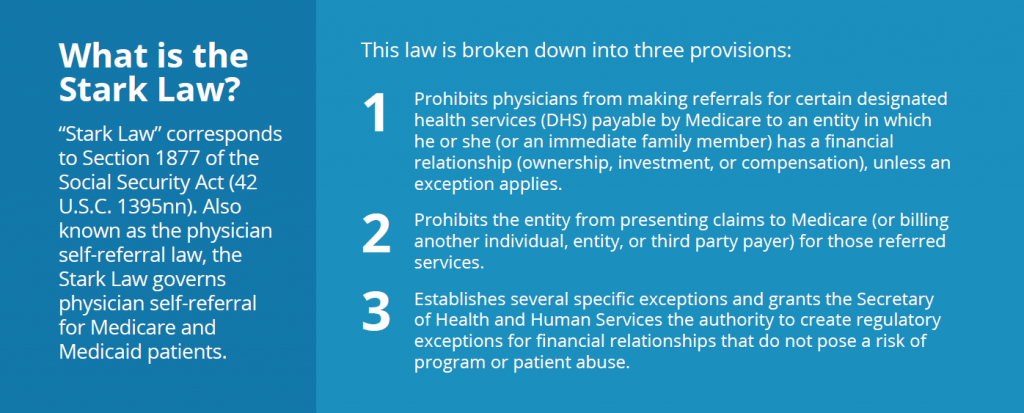
§ 1395nn), originally named the patient referrals act, prohibits a physician from referring medicare or medicaid patients to an entity with which the physician or immediate family member has a financial relationship. The stark law what does the stark law prohibit? These designated health services include:
These statutes currently reside under the purview of centers for medicare & medicaid services (cms) fraud and abuse laws. A financial interest includes compensation, ownership and investment interests. These types of referrals are prohibited by law because these “designated health services” are generally payable by medicare or medicaid, which are federal healthcare programs.
The law aims to protect the medicare population from an overprescribing of unnecessary medical services. Stark law or the “physician referral law” is a set of laws that forbids doctors from referring patients to a “designated health service” with which they have a financial relationship. This means that a physician can violate it without intentionally meaning to do so.
The stark law is a healthcare fraud and abuse law that prohibits physicians from referring patients for certain designated health services paid for by medicare to any entity in which they have a “financial relationship.” the federal government interprets the term “financial relationship” broadly to include any direct. The stark law (42 u.s.c. Such reactions are understandable given how easy it is to violate the law and how severe the penalties are.
Stark law defines a financial relationship as any financial connection, direct or indirect, whereby a physician or other healthcare provider has an interest in an entity and engages in a compensation arrangement between the entity and healthcare provider or immediate family member. Those services are legally defined as designated health services (“dhs”) which include laboratory, physical therapy, radiology, and hospital services. Nevertheless, compliance is mandatory, and penalties can apply to the physician or designated health services provider who makes or benefits from a prohibited referral.
Previous post
What is the symptoms of ibs